

Honolulu’s Forgotten Child: Piecing Together the Disappearance of Jie Zhao Li
Introduction
She walked out into the warm Honolulu afternoon with a stack of fundraiser tickets, a borrowed wristwatch, and the kind of innocent determination only a twelve‑year‑old can carry. She was supposed to be home by six. She never made it back.
On February 11, 1988, Jie Zhao Li, a bright, soft‑spoken sixth‑grader who had immigrated from China just three years earlier, disappeared while selling Zippy’s Chili tickets for her school. She vanished somewhere between a 7‑Eleven, a busy intersection, and the watchful eyes of a community that would spend decades wondering how a child could simply dissolve into the daylight.
This isn’t just a missing‑child case.
It’s a Honolulu ghost story.
A girl lost.
A city haunted.
And a question that still lingers in the humid air of Nuuanu Avenue:
How does a child disappear in plain sight?
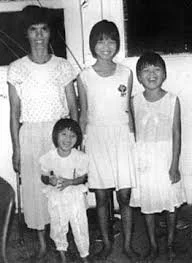
Image Credit: NCMEC
Jie with her mother, older sister, and younger sister
A Life Interrupted
Jie Zhao Li was born in China in 1975, the youngest daughter in a family that uprooted their lives for a better future in Hawaii. By 1988, she was thriving at Royal Elementary School, learning English, making friends, and embracing the small joys of childhood.
The fundraiser was simple: sell Zippy’s Chili tickets to raise money for a school trip. Kids did it every year. They sold outside shops, at bus stops, door‑to‑door. It was normal. Safe. Expected.
Before she left, her mother slipped an oversized wristwatch onto her arm, a reminder to be home by six.
It would become one of the last things Jie ever wore.
On the afternoon she disappeared, Jie was dressed simply, the way many twelve‑year‑olds were in Honolulu in the late 1980s. She wore a yellow T‑shirt, simple shorts, and carried a dark blue purse slung across her body, the one holding her Zippy’s Chili fundraiser tickets. Her mother had fastened an adult‑sized wristwatch around her wrist before she left, the band slightly loose against her small arm.
She was still very much a child.
Despite being twelve, she still had several milk teeth, and the ones that had come in were slightly crooked, giving her smile a softness that made her look younger than her age. It was one of the details her family always mentioned, the way her teeth made her instantly recognizable, the way her smile seemed to belong to someone a little smaller, a little more innocent. She was approximately 4'11, and weighed roughly 75lbs, she had short, straight black hair, brown eyes and was of Asian Chinese descent.
These details became crucial in the search.
They were printed on flyers, repeated in news reports, and described to every driver stopped at the roadblocks. Her clothing, her purse, her watch, her uneven teeth, all the small, ordinary things that should have meant nothing, but suddenly meant everything.
The Last Known Hours
4:00 p.m. — Leaving Home
The afternoon was warm but gentle, the kind of Honolulu day where the light feels soft and unthreatening. Jie stepped out of her family’s apartment wearing a yellow T‑shirt and simple shorts, her dark blue purse slung carefully across her body. Inside were the Zippy’s Chili tickets she hoped to sell for her school fundraiser, a task she took seriously, even proudly.
Before she left, her mother had fastened an adult‑sized wristwatch around her small wrist. It hung a little loose, but it was meant to guide her home by six. Jie nodded, promised she would be back, and walked toward the familiar stretch of Nuuanu Avenue, a route she had travelled many times without incident.
4:45 p.m. — The 7‑Eleven and the Nachos

Image Credit: clickamericana.com
Depiction of a 7 Eleven Store in the 80’s
By late afternoon, Jie had reached the 7‑Eleven at Nuuanu and Kuakini, a busy corner where the flow of customers never really stopped. Several witnesses later recalled seeing her there, a polite, soft‑spoken girl approaching people with her fundraiser pitch, her voice barely rising above the hum of traffic.
Inside the store, she had a brief interaction that would become one of the last confirmed moments of her day. According to the clerk, Jie approached the counter holding a tray of nachos. She tried to pay for them with one of her fundraiser tickets, a small, earnest misunderstanding that spoke to her age and innocence. The clerk gently explained that the ticket wasn’t valid as payment. Jie accepted this without fuss, put the nachos back, and stepped outside again.
It was a fleeting exchange, but it anchored her in time and place. She was alive, alert, and still focused on her task.
Outside, witnesses saw her continuing to sell tickets, approaching customers as they entered and exited, speaking to drivers who slowed at the curb, leaning toward open car windows to be heard over the traffic.
Among the many fragments of witness testimony gathered in the days after Jie vanished, one detail surfaced again and again: a man standing outside the 7‑Eleven, speaking with her shortly before she disappeared. He wasn’t someone anyone recognized, not a neighbor, not a regular customer, not a familiar face from the area. He was simply there, lingering near the entrance, watching the flow of people and cars.
Witnesses described him as a white male, likely in his 30s, with dirty blond or light brown hair that looked unkempt, as though he had been outside for hours. His clothing was ordinary enough that no one remembered specifics, but his presence stayed with people, not because he did anything overtly alarming, but because he was one of the last adults seen interacting with Jie.
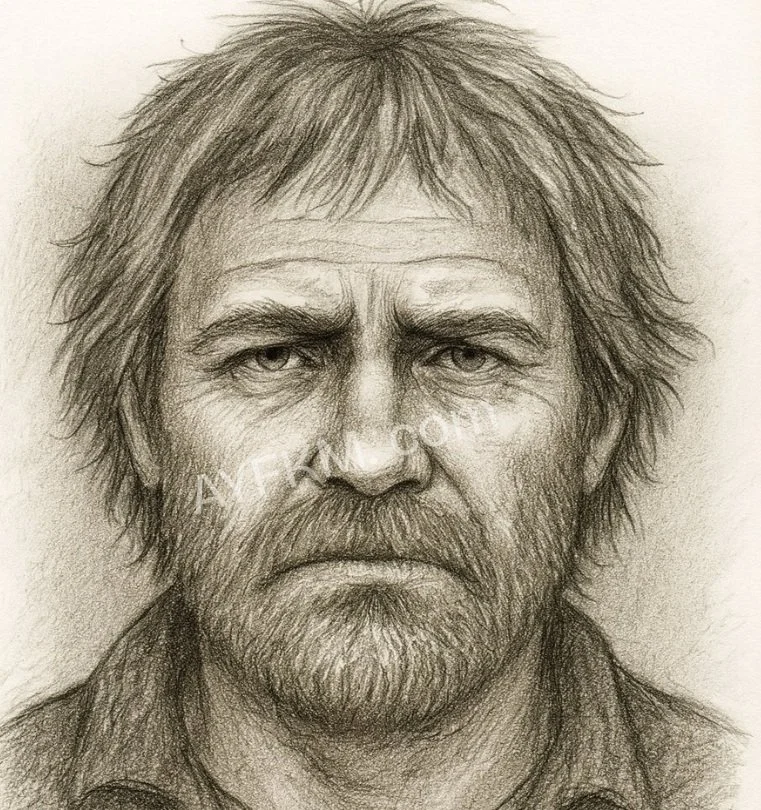
Image Credit: AreYouFuckingKillingMe.com
AI generated image of composite sketch
Police took the accounts seriously. A composite sketch was created based on the descriptions, and for weeks it appeared in newspapers, on bulletin boards, and taped to storefront windows. The sketch showed a man with a narrow face, tired eyes, and that distinctive fair, slightly messy hair. It was circulated widely, but no one ever came forward to identify him. No co-worker, no friend, no passer-by recognised the face. He remained a ghost in the investigation, present in the narrative, but unreachable.
What he said to Jie, if anything, is unknown.
Whether he was simply a customer buying a drink or someone who noticed a young girl selling tickets alone is a question that has never been answered.
He might have been harmless.
He might have been the last person to see her alive.
He might have been the reason she never came home.
The investigation could never determine which possibility was true.
But his presence, and the silence that followed, has lingered over the case ever since.
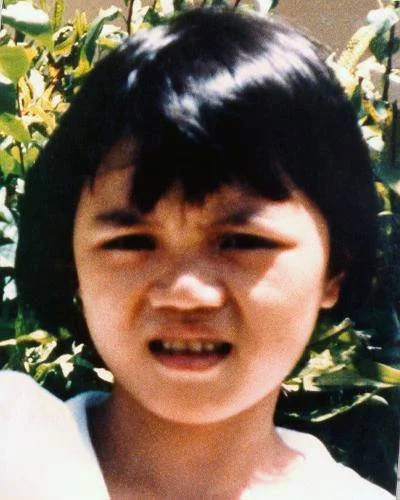
Image Credit: Google
Jie Zhan Li
And then there was the car.
Of all the details that surfaced in the early days of the investigation, none captured the public imagination, or the police’s attention, quite like the yellow Chevrolet sedan. It was an old car, a relic from the 1950s, the kind of vehicle that stood out sharply against the more modern traffic moving through Nuuanu Avenue in 1988. Its colour alone made it memorable, but its age, its shape, and its presence near the 7‑Eleven that afternoon gave it a weight that has never fully lifted from the case.

Image Credit: Pinterest
A yellow Chevrolet Sedan approx. 1950’s make and model
Several witnesses reported seeing a girl who looked like Jie near the car sometime between 5:00 and 5:15 p.m. Some remembered her standing close to the passenger side, speaking to the driver through the open window. Others believed she leaned in slightly, the way she had been doing with other cars as she tried to sell her fundraiser tickets. A few were convinced they saw her climb inside, a detail that, if true, would mark the moment everything changed.
But none of these accounts matched perfectly.
Some placed the car directly in front of the 7‑Eleven.
Others insisted it was parked a short distance away.
A few described the driver as a man with light hair, while others couldn’t recall anything about him at all.

Image Credit: Google
Side profile of an Olive coloured Chevy Sedan (approx. 1950 make and model)
Memory is a fragile thing, especially when it becomes the hinge on which a child’s fate might turn. The police treated every sighting seriously, but the inconsistencies made it impossible to confirm whether Jie ever entered the vehicle, or whether the car had anything to do with her disappearance at all.
Still, the yellow Chevy became the centrepiece of the investigation. Detectives tracked down every owner of a 1955–1957 Chevrolet on Oahu, inspecting each vehicle, interviewing each driver, and reconstructing their movements on the afternoon Jie vanished. It was an exhaustive effort, one that consumed weeks of investigative time.
And yet, nothing came of it.
No car showed signs of involvement.
No driver emerged as a suspect.
No witness could provide a detail that tied the vehicle definitively to Jie.
The yellow Chevrolet remained what it had been from the beginning, a possibility. A shadow. A detail that might have meant everything or nothing at all. But for many who followed the case, it became the symbol of the moment Jie slipped out of sight, the last image of her moving through the world before the trail went cold.
Wider Police Timeline: 3:30 p.m. – 5:15 p.m.
Although the 7‑Eleven interaction remains the last confirmed sighting of Jie, police later gathered a broader window of possible sightings stretching from 3:30 p.m. to 5:15 p.m. These accounts varied in detail and reliability, but together they formed the framework investigators used to reconstruct her final movements.
Some residents reported seeing a girl who resembled Jie as early as 3:30 p.m., walking along Nuuanu Avenue with a stack of tickets in her hand. These early sightings were never verified, they may have been Jie, or they may have been another child in the neighbourhood, but they were consistent enough with her intended route that detectives included them in the official timeline.
Between 4:00 and 4:30 p.m., several people recalled a young girl going door‑to‑door in the blocks between her apartment and the 7‑Eleven. These accounts aligned with what Jie had set out to do, though none of the witnesses could say with certainty that it was her. Still, the descriptions matched her clothing, her age, and her purpose that afternoon.
After the confirmed 7‑Eleven sighting at 4:45 p.m., the timeline extends slightly further. A handful of witnesses reported seeing a girl matching Jie’s description between 5:00 and 5:15 p.m., near the area where the yellow 1950s Chevrolet was later reported. Some believed she was speaking to the driver. Others thought she leaned toward the open passenger window. A few were convinced she may have gotten inside.
None of these later sightings could be corroborated, and each carried its own uncertainties. But taken together, they formed the final, fragile thread of Jie’s known movements, a window of time in which she was still visible to the world, still moving through the neighbourhood, still within reach.
After 5:15 p.m., the sightings stop.
And the trail goes quiet.
6:00 p.m. — The Missed Return
By six o’clock, she was expected home. As the evening settled over the neighbourhood, her mother began to watch the time more closely, glancing toward the window, then the door, listening for footsteps on the stairs. The minutes stretched, then slipped into an hour. The sun dipped behind the buildings, the streetlights flickered on, and the familiar sounds of the evening rose around the apartment.
Still, Jie did not return.
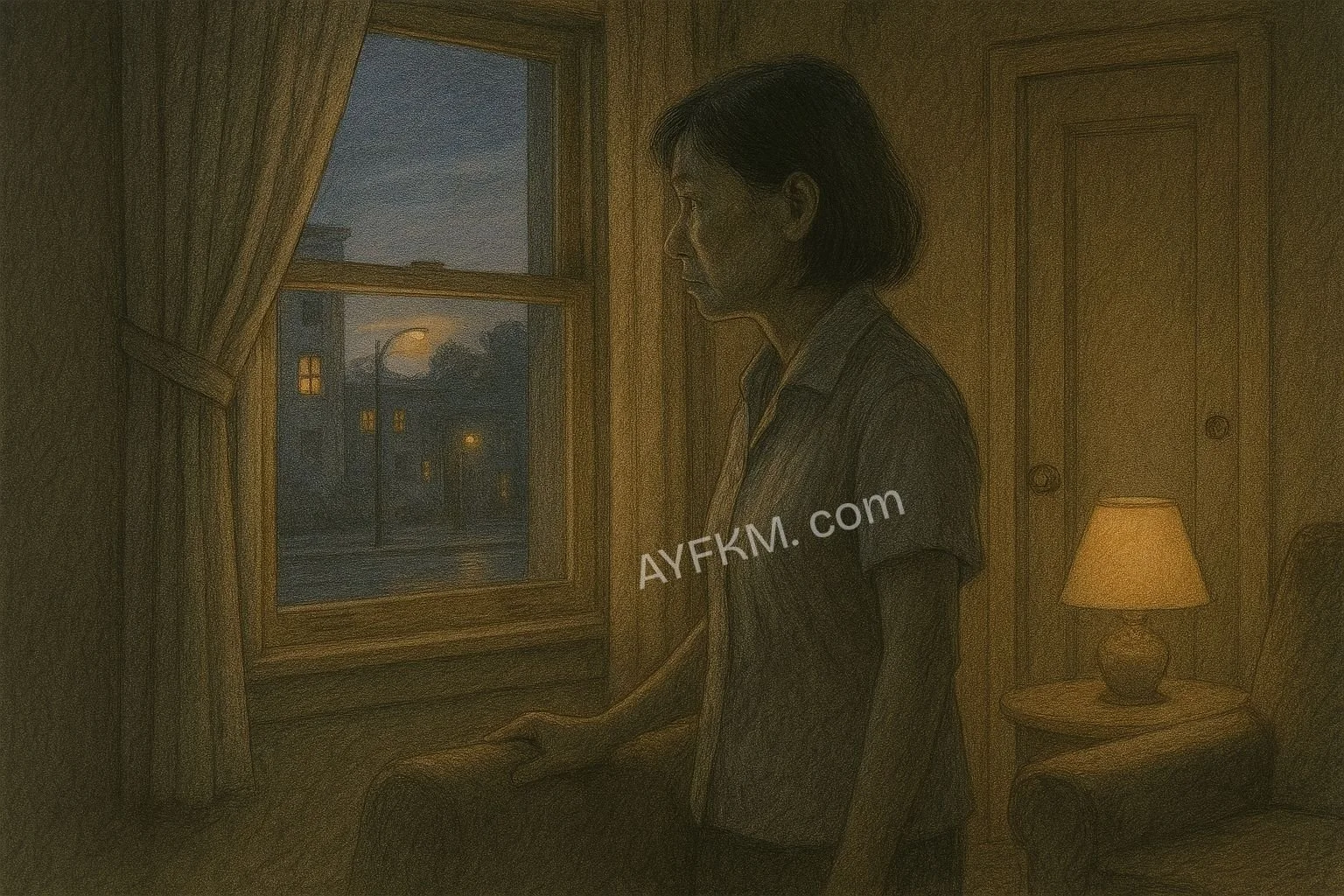
Image Credit: AreYouFuckingKillingMe.com
AI generated image of Mrs Li (mother) waiting by window at dusk, hoping missing daughter Jie Zhao Li will return.
That Evening — The Family’s Search
As the sky darkened, worry hardened into fear. Jie’s family searched the immediate area first, the route she usually walked, the nearby shops, the corners where children often gathered. They asked neighbours, store clerks, anyone who might have seen her. No one had.
When it became clear she was not simply delayed, they contacted the police that same night. Officers responded quickly, canvassing the neighbourhood, speaking with witnesses at the 7‑Eleven, and retracing the path Jie was believed to have taken. But the darkness had already settled in, and whatever had happened to her had left no immediate trace.
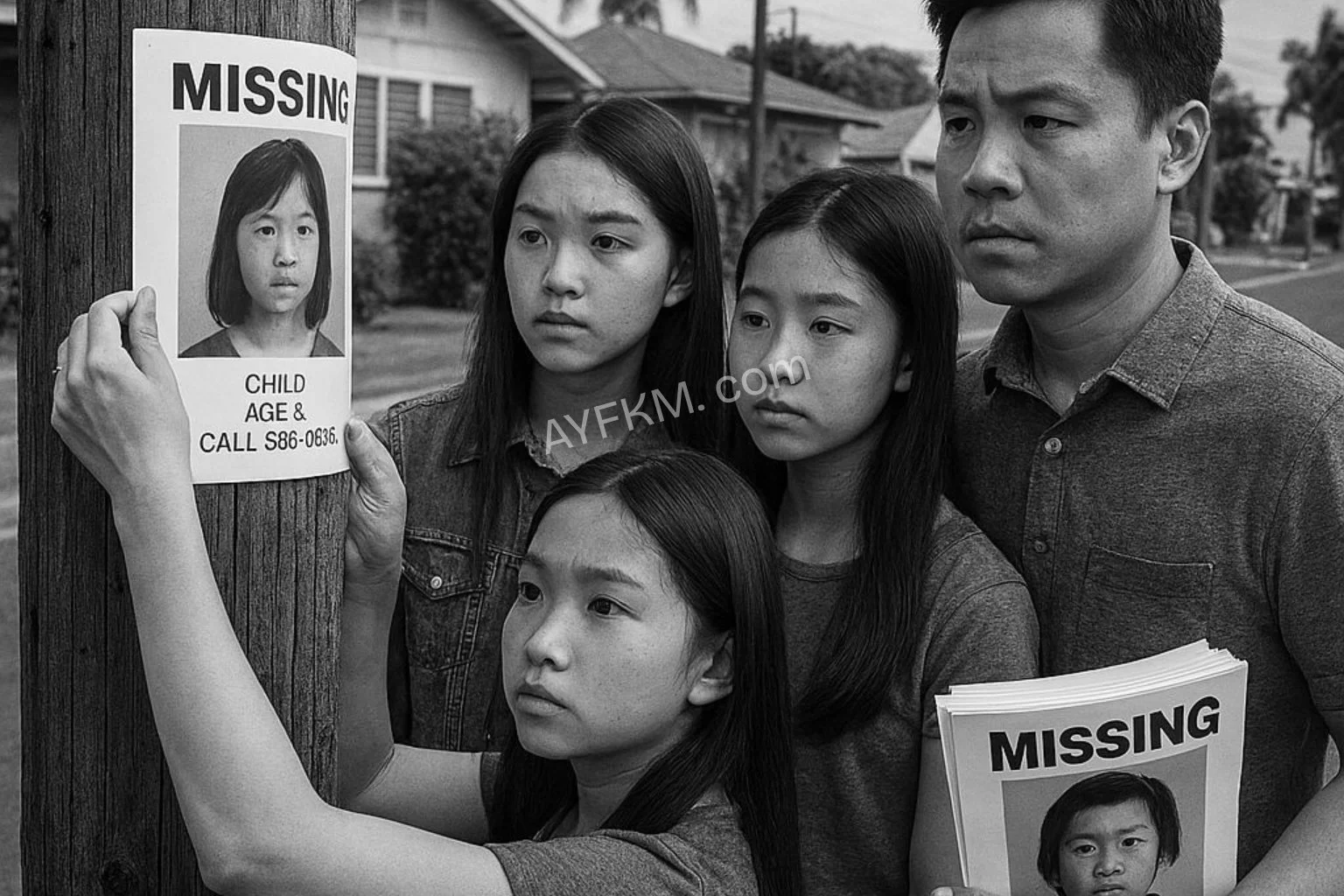
Image Credit: AreYouFuckingKillingMe.com
AI Generated Image depicting family or community members posting missing child flyers for Jie Zhao Li on a city street.
The Next Morning — The Search Intensifies
At first light on February 12, the Honolulu Police Department escalated Jie’s disappearance into a full‑scale missing‑child operation. What had begun as a frantic family search the night before now widened into a coordinated effort involving officers, volunteers, and eventually the broader Honolulu community.
Roadblocks were set up throughout the Nuuanu and Liliha areas, with officers stopping cars, showing drivers Jie’s photo, and asking whether anyone had seen her the previous afternoon. The questions were simple but urgent, “Did you pass this corner?” “Did you see this girl?” “Did anything seem out of place?” For hours, traffic slowed to a crawl as police tried to capture any detail that might anchor Jie’s movements after 5:15 p.m.
Search teams moved through ravines, wooded areas, drainage ditches, and the dense pockets of vegetation that bordered the neighbourhood. Officers walked shoulder‑to‑shoulder through underbrush, calling her name, listening for any sound that might break the silence. Flyers bearing Jie’s face were posted across the community, on telephone poles, in shop windows, at bus stops, and in the hands of volunteers who refused to let her image fade.
Frank Lee’s Instructions and the Expanding Search
Assistant Police Chief Frank Lee directed much of the early search strategy. Under his guidance, the operation expanded rapidly. Officers were instructed to widen the perimeter beyond Nuuanu Avenue, pushing into areas where a child might wander, or be taken, in the hours after she was last seen. Teams were sent into Liliha, Pauoa, and the lower reaches of Pacific Heights, combing terrain that was steep, tangled, and unforgiving.
Lee emphasized thoroughness over speed. Every ravine, every cul‑de‑sac, every footpath was to be checked. If a lead emerged, no matter how small, it was followed.
Off‑Duty Military Personnel Join the Effort
As news of Jie’s disappearance spread, off‑duty military personnel from nearby bases volunteered to help. Many were parents themselves; others simply felt compelled to act. They joined the search lines, using their training to navigate difficult terrain and cover ground quickly. Their presence added manpower, structure, and a sense of urgency to an already massive operation.
By the end of the first week, more than 39,000 man‑hours had been poured into the search, one of the largest efforts Honolulu had ever mounted for a missing child.
False Leads and Discounted Sightings
Not every report that came in could be trusted, and investigators had to sift through each one carefully.
One account involved a young boy who claimed he had grabbed Jie’s arm earlier that morning, around 10 a.m., insisting she was his sister. The timing alone made the story impossible, Jie was at school at that hour, and the boy’s description shifted each time he repeated it. Police ultimately dismissed the claim as a misunderstanding or a child seeking attention.
Another report described an older Asian man seen walking with a girl who resembled Jie around 5 p.m. on the day she disappeared. But no other witnesses corroborated the sighting, and the description of the girl didn’t fully match Jie. Investigators could never determine whether the child seen was Jie or simply another girl in the neighbourhood.
These leads, like so many others, dissolved under scrutiny.
A Search Without Answers
Despite the scale of the operation, the roadblocks, the expanded search zones, the military volunteers, the thousands of hours spent combing the landscape, no physical evidence was ever found. No clothing. No purse. No fundraiser tickets. Nothing that could explain how a twelve‑year‑old girl vanished in broad daylight on a busy Honolulu street.
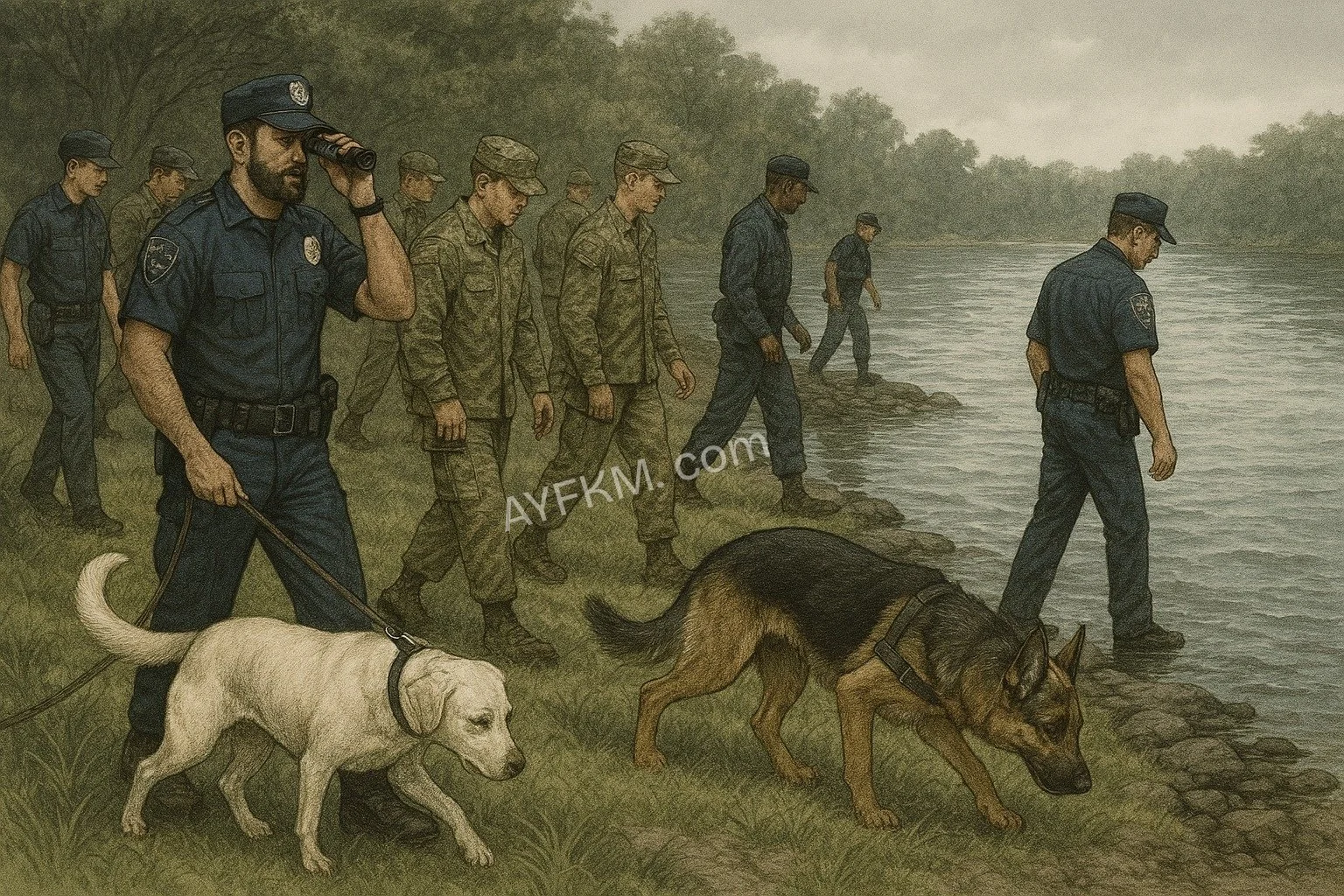
Image Credit: AreYouFuckingKillingMe.com
AI generated image of Police and military search riverbank with cadaver dogs for missing girl Jie Zhao Li
The search continued for weeks, then months, but the trail had gone cold almost as soon as it began.
Lingering Speculation and the Search That Lost Momentum
As the days stretched into weeks, the investigation began to shift from frantic urgency to a slower, more methodical grind. Assistant Police Chief Frank Lee, who had overseen much of the early search strategy, had been instrumental in expanding the search radius, coordinating roadblocks, and directing officers into the steep, tangled terrain surrounding Nuuanu. But midway through the operation, Lee became unwell, and his absence created a noticeable lull. Without his coordination, the search lost some of its early momentum, and the operation that had once moved with near‑military precision began to slow.
In the vacuum left by the lack of answers, speculation began to grow. Some residents whispered about the possibility of sex trafficking, a fear rooted more in the suddenness of Jie’s disappearance than in any evidence. Honolulu had seen trafficking cases before, and the idea that a young immigrant girl could vanish without a trace fed into those anxieties. But investigators never found anything to support the theory. No leads, no patterns, no connections to known trafficking networks. The Honolulu Police Department did not pursue trafficking as a formal line of inquiry, and no part of the official investigation ever tied Jie’s disappearance to such activity.
Still, the absence of evidence created space for fear to fill in the blanks.
Keeping Her Face Alive — The Age Progression
Years passed without answers, but efforts to keep Jie’s case visible did not stop. The National Center for Missing and Exploited Children (NCMEC) created an age‑progressed image of Jie at nineteen, showing what she might have looked like seven years after she vanished. The photo was distributed nationally through a partnership with Advo, Inc., a company known for printing missing‑child images on direct‑mail advertising that reached millions of households across the United States.
It was a way of keeping her face in the public eye, a reminder that she was still missing, still loved, still sought. The hope was simple: that someone, somewhere, might recognize her.
This time, the response was different.
The age‑progressed image generated nearly thirty leads, each one a flicker of possibility: a girl seen in a store, a young woman who resembled the picture, a memory someone had tucked away for years. Investigators followed up on every call, tracing each thread as far as it would go.
But none of the leads held.
None brought Jie closer.
None revealed where she had been or what had happened to her.
The age progression kept her face alive in the public consciousness, but like so many efforts before it, it brought the investigation no closer to the truth.
Keeping Her Face Alive — And the Leads That Followed
Years passed without answers, but efforts to keep Jie’s case visible did not stop. The National Center for Missing and Exploited Children (NCMEC) created an age‑progressed image of Jie at nineteen, showing what she might have looked like seven years after she vanished. The photo was distributed nationally through a partnership with Advo, Inc., whose direct‑mail advertising reached millions of households across the United States.
It was a way of keeping her face in the public eye, a reminder that she was still missing, still loved, still sought. The hope was simple: that someone, somewhere, might recognize her.
This time, the response was different.
The age‑progressed image generated nearly thirty leads, each one a flicker of possibility: a girl seen in a store, a young woman who resembled the picture, a memory someone had tucked away for years. Investigators followed up on every call, tracing each thread as far as it would go.
But none of the leads held.
None brought Jie closer.
None revealed where she had been or what had happened to her.
Still, NCMEC did not let her case fade. Years later, they created a second age progression, this time showing Jie at thirty‑two. The image was older, more mature, shaped by the life she might have lived had she grown into adulthood. It was a quiet acknowledgment of time passing, of birthdays missed, of a family still waiting.
The age progressions kept her face alive in the public consciousness, but like so many efforts before them, they brought the investigation no closer to the truth.

Image Credit: National Center for Missing and Exploited Children
Jie Zhao Li - Age Progression image (aged 37)
The Lead That Went Nowhere
In the years after Jie vanished, investigators chased every thread that might bring them closer to the truth, even the ones that seemed unlikely at first glance. One such lead emerged when a beat cop approached Lt. Diaz, pointing him toward a man in the neighborhood who had a history of mental illness and had been accused of harassing women. The man was described as schizophrenic, unpredictable, and known to wander the area near where Jie disappeared.
What caught Diaz’s attention wasn’t just the man’s reputation, but the way he spoke when questioned, fragmented, unsettling, and threaded with comments that seemed to brush too close to the details of the case. It was enough to make Diaz pause, enough to make him wonder whether the man had seen something, or knew something, or had been somewhere he shouldn’t have been.
The lead grew into a full‑scale operation.
Search teams were sent into the stream bed the man mentioned, a stretch of tangled brush and running water that cut through the neighbourhood. Cadaver dogs and sniffer dogs were brought in, combing the area for any trace of Jie. Officers waded through mud, sifted through debris, and searched every bend and hollow where evidence might hide.
Nothing was found.
Still, Diaz continued to question the man, hoping that repetition might shake loose a detail or a confession. Instead, the situation took a darker turn. One night, the man appeared at Lt. Diaz’s home, agitated and threatening. It was a moment that underscored both the volatility of the lead and the fragility of the man at the centre of it.
He was arrested and placed into mental health care, where he remained under supervision. But even after multiple interviews, no one could determine whether he truly knew anything about Jie’s disappearance, or whether his comments were simply the disjointed echoes of an unwell mind.
The lead, like so many others, dissolved into uncertainty.
A possibility that flickered briefly, then faded.
Another path that led nowhere.
The Reward That Brought No Answers
In the days after Jie vanished, the community response grew far beyond the neighbourhood where she was last seen. Donations began to arrive from local residents, small businesses, and people who had never met Jie but felt the ache of her disappearance. The Chinese‑American community, in particular, rallied around her family. Churches, cultural associations, and business owners contributed what they could, determined to help bring the young girl home.
A significant portion of the reward fund came from the Chinese Consulate, which stepped in to support the family during the early stages of the investigation. Their contribution, combined with donations from Honolulu residents and local organizations, helped establish a $10,000 reward, a substantial amount for 1988, especially for a working‑class immigrant community.
Flyers announcing the reward were posted alongside Jie’s missing posters, taped to storefronts, bus stops, and telephone poles. The number was printed boldly, a plea and a promise: that someone, somewhere, might know something.
But despite the size of the reward and the breadth of the outreach, no one came forward with information that led anywhere. No tip broke the silence. No lead emerged from the promise of money.
The reward remained unclaimed, a painful reminder that whatever happened to Jie had left no easy trail to follow, and no one willing or able to speak.
Theories: What Could Have Happened?
A Stranger Abduction
The most widely accepted theory. Jie was alone, visible, and interacting with strangers, a perfect target for an opportunistic predator.
A Crime of Opportunity
Someone sees a child selling tickets.
Someone stops.
Someone acts.
Quickly. Quietly. Efficiently.
Mistaken Sightings and Prank Calls
Reports of Jie in the days that followed were never confirmed.
Hope can distort memory.
Fear can sharpen it.
Neither produced answers.
As the investigation widened, police found themselves sifting through a growing number of sightings, tips, and claims, some offered in good faith, others born from confusion, and a few from cruelty.
One of the earliest reports came from anonymous person who claimed they had seen Jie around 10 a.m. on the day she disappeared. They said a young Asian boy had grabbed her arm, insisting she was his sister. The story was strange, unsettling, and oddly specific, but impossible. At that hour, Jie was at school, surrounded by classmates and teachers. The boy’s description shifted each time they repeated it, and investigators ultimately dismissed the account as a child seeking attention in the middle of a case that had suddenly consumed the community.
Another sighting emerged later: a report of Jie speaking with an older Asian man outside the 7‑Eleven around 5 p.m. The detail was striking — a girl matching her description, a man no one recognised, but no other witness saw them together. No one recalled an older man lingering outside the store. No one could confirm the interaction. And the description of the girl didn’t fully match Jie. Investigators could never determine whether the child seen was her or simply another girl passing through the neighbourhood at the wrong moment.
These leads, like so many others, dissolved under scrutiny.
And then came the calls.
As the days turned into weeks and the search stretched on with no answers, the family began receiving phone calls, not from witnesses, not from people offering help, but from strangers who seemed to take some twisted satisfaction in their pain. Some calls were nothing more than heavy breathing on the other end of the line. Others were voices pretending to have seen Jie, or claiming to know where she was, only to hang up before giving any detail.
A few were worse.
They hinted at things no parent should ever have to hear, spoken by people who had no connection to the case, no information, no purpose other than to wound. Each call forced the family to relive the fear of that first night, reopening the wound just as it began to scab over.
Police traced what they could, but most of the calls came from payphones or unlisted numbers, the work of people who hid behind anonymity. None of them led anywhere. None of them offered even a fragment of truth.
For Jie’s mother, every ring of the phone became a moment suspended between hope and dread. She answered each call because she had to. Because not answering felt like giving up. Because even the cruellest hoax carried, for a heartbeat, the possibility that someone might finally tell her where her daughter was
A Case That Refused to Fade
For years, Jie’s disappearance lived in the quiet corners of Honolulu’s collective memory, until the internet resurrected her story.
Trace Evidence Podcast
Episode 199 reconstructed her final hours, examined the witness accounts, and reignited public interest. It remains the most comprehensive audio retelling of her case.
r/GratefulDoe Community
A widely shared Reddit post gathered:
• Local recollections
• Memories of flyers blanketing the neighborhood
• Cultural context about fundraiser safety
• Additional nuance about the yellow Chevy sightings
It didn’t solve the case. But it keeps her name alive, and it’s how we came to hear about her disappearance.
Where the Case Stands
• Jie remains missing.
• Age‑progressed images exist.
• The Honolulu Police Department still lists her as an open case.
• Her family kept the same phone number for decades, hoping she might call.
There have been no confirmed sightings since 1988.
The Family Left Behind
In the years after Jie vanished, her family’s life reshaped itself around her absence. The apartment where she had last been seen leaving at four o’clock became too heavy with memory, too full of the silence she left behind. Eventually, the family moved, not to forget her, but because staying felt like trying to live inside a wound that would not close.
Her mother kept the things that mattered most. Among them was a Valentine’s Day card she had bought for Jie the week she disappeared, a small, simple gesture meant for a celebration that never came. She kept it tucked away, still unwritten, still waiting. It became a symbol of all the moments that would never be shared, all the milestones that would pass without her daughter there to mark them.
When the media descended in the early days of the search, the family handed over photographs of Jie, the ones they cherished, the ones that captured her smile, her softness, her youth. Some of those photos were never returned. They vanished into newsrooms, archives, or drawers, leaving the family with fewer images than they had before the world knew her name. Her mother never stopped regretting that loss.
But she held on to one thing with absolute certainty: Jie’s photo number, the identifier used by police and missing‑child organizations. She memorised it, repeated it, kept it close as if knowing it by heart might somehow tether Jie to the world a little longer.
Life moved forward in ways that felt both necessary and cruel. Her mother eventually became a United States citizen, a milestone she had once imagined celebrating with her daughter at her side. Instead, she carried Jie with her in spirit, her absence woven into the moment like a second shadow.
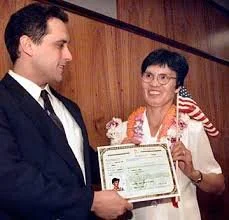
Image Credit: Google.com
Mrs Li celebrating her US citizenship
Jie’s father’s health declined over the years, worn down by time, grief, and the quiet ache of not knowing. He never stopped hoping for answers, but the weight of uncertainty settled heavily on him. The search had ended, the leads had dried up, but the longing — the need to understand what happened to their daughter, never eased.
For the family, Jie’s disappearance was not a case.
It was a life interrupted.
A future stolen.
A story without an ending.
And they carried it with them, every day, in every move, in every milestone, in every memory that refused to fade.
A Girl Lost, A Question Unanswered
The disappearance of Jie Zhao Li is a wound that never healed, a story of a child who walked into the afternoon sun and never returned. A fundraiser that should have been ordinary. A community that searched until its feet blistered. A family that waited by the phone for years.
Jie’s disappearance is the kind of story that leaves a mark on a place. Not because of what is known, but because of everything that isn’t. A twelve‑year‑old girl walked out of her apartment on a warm February afternoon in 1988, carrying fundraiser tickets and wearing a loose wristwatch, and she never came home. In the decades since, the case has become a quiet wound in Honolulu’s history, one that never fully healed, one that still aches when touched.
The investigation stretched across ravines, neighbourhoods, and years. It pulled in police officers, volunteers, off‑duty military personnel, cadaver dogs, and entire communities. It generated sketches, roadblocks, age progressions, and nearly thirty leads. It produced theories, suspects, false sightings, and moments of hope that dissolved as quickly as they appeared.
And yet, nothing concrete was ever found.
No evidence.
No remains.
No explanation.
For Jie’s family, the absence became its own kind of presence. They moved homes, but the loss followed them. Her mother kept the Valentine’s card she never had the chance to give her, memorized her missing‑child photo number, and held on to the few photographs the media returned. She became a U.S. citizen without her daughter beside her. Her father’s health declined under the weight of years spent waiting for an answer that never came.
Time moved forward, but the story did not.
Theories continue to circulate, stranger abduction, misidentification, the yellow Chevrolet, the man outside the 7‑Eleven, the schizophrenic neighbor, the possibility of something darker. But none have ever been proven. None have ever brought Jie home.
What remains is a girl frozen in memory: crooked baby teeth, a yellow T‑shirt, a blue purse, a smile that made her look younger than twelve. A child who should have grown into adulthood, who should have celebrated birthdays, graduations, and milestones her family still imagines in the quiet moments.
Cases like Jie’s linger not because they are sensational, but because they are unbearably ordinary. A child vanished in daylight. A family broke open. A community searched. And the world kept turning.
But somewhere, someone knows what happened.
Someone saw something.
Someone remembers.
Until that truth surfaces, Jie remains where she has been for thirty‑six years, not forgotten, not dismissed, but suspended in the space between hope and grief, a story without an ending, a question still waiting for its answer. Her mother believes she is still out there, somewhere, alive, and that one day she will find her way home.
Call to Action
Jie Zhao Li’s case remains open.
Her family has never stopped hoping for answers, and investigators have never closed the door on new information.
Her case is listed with the National Center for Missing and Exploited Children under:
Case Number: 601694
Name: Jie Zhao Li
Missing Since: February 11, 1988
Location: Honolulu, Hawaii
If you have any information, no matter how small it may seem, you can contact:
Honolulu Police Department
Honolulu Police Department Case Reference: B49038
(808) 529‑3115
National Center for Missing and Exploited Children (NCMEC)
1‑800‑THE‑LOST (1‑800‑843‑5678)
If you prefer to remain anonymous, you may also contact the author of this investigation directly. Any information shared will be forwarded to the appropriate authorities:
Email: areyoufookingkillingme@outlook.com
Even after decades, a single memory, detail, or name could bring clarity to a case that has remained unanswered for far too long. Someone knows what happened to Jie. If you do, please come forward. If Jie is alive she would be 50-years old